♥
♥
♥
♥
♥
♥
♥
From my view, the cast of characters ZUN has created in the Touhou franchise are greatly entertaining, but rarely live up to their full potential. There will be little snippets of exciting information or potential future plot points, such as hints towards Sakuya having a past relationship to Eirin, or Rumia's magic amulet--but it will always stay at that early stage, as ZUN never returns to these ideas to execute them. Many of these plot points become essentially forgotten, as he might not ever return to the character in question to begin with.
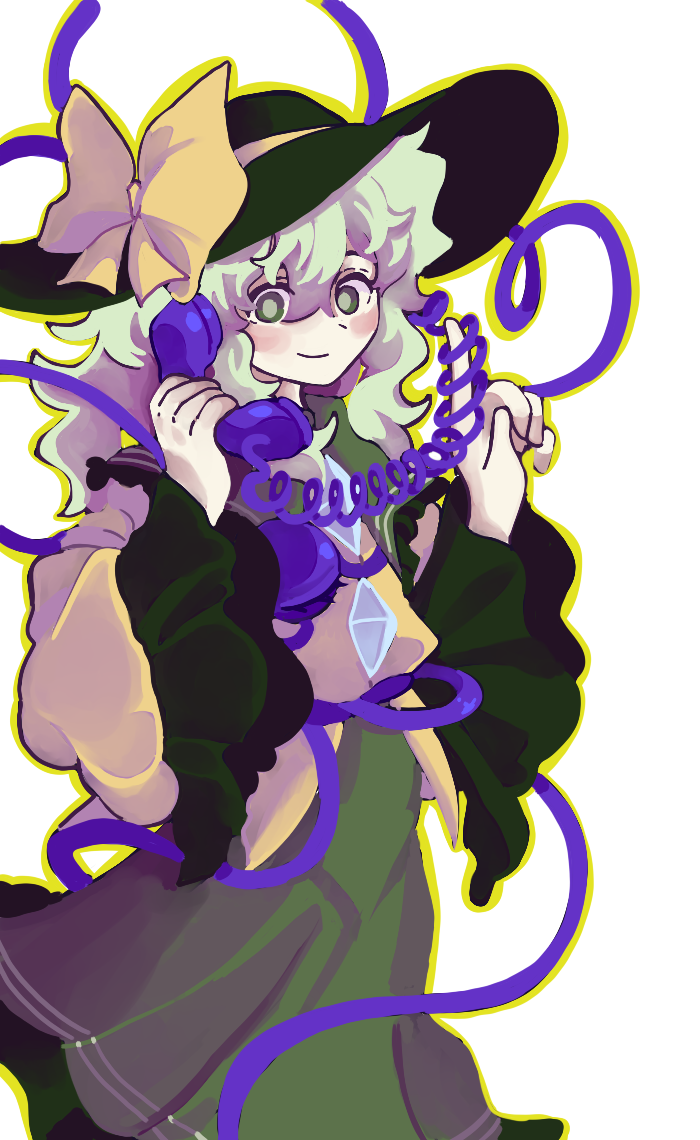
One major missed opportunity is the relationship Koishi has between her and another character, Marisa Kirisame. Koishi and Marisa were duo partners in the game Antinomy of Common Flowers, where they have an entire story arc featuring them investigating the central incident. However, Koishi essentially functions as a pointless comedic relief character with absolutely no impact to the story or relation to it whatsoever--and even furthermore, she has no dynamic with Marisa. Other characters in the story comment on their partnership about how the two do not seem to suit eachother, and Marisa admits at one point that it was a mistake to pair with Koishi in the first place. (1) At a later point in the series, Marisa does reflect on this and now thinks that Koishi was relatively straightforward and easy to work with. (2)
Some readers may think this makes enough sense, as Koishi and Marisa appear to have little in common on the surface, but in my own readings I discovered some information about Marisa that leads me to believe that she should be much more compelled towards Koishi than she is now in canon. These two have a great potential to have a dynamic, interesting partnership from a story-telling perspective that any author could work wonders with.
As it exists in the Touhou universe, magic is left rather vague and unexplained by the series creator. However, looking deeply into Marisa in particular, it becomes evident that the specific form of magic she practices is rooted in Western Magic. This is something that might seem completely unrelated to the topic of this blogpost, but it is actually extremely important so just trust me.
The first, most direct evidence of this comes from the official title Marisa is given in the game the Embodiment of Scarlet Devil, as she is described as a "Oriental Western Magician." (3) Marisa herself is oriental, as despite having blonde hair her name is completely in Japanese, and so "Western Magician" is specifying the type of magic she practices, meaning it is rooted in the ideas and theory of Western Magic. There are plenty of more supplementary signs for this, as Marisa as a character is full of cultural iconography associating her with Western Magic. It's important to understand that the sort of things we typically think of when we hear the word "magic"--such as wands, witches, cauldrons and broomsticks--were not invented by Harry Potter or some other series! All of the cultural symbols of "magic" and "witchcraft" come from a real life historical tradition, sometimes encompassing many different cultures from throughout the world, where magic was an actual, real, tangible practice important to the lives of many people.
To begin with, Marisa is depicted as holding a wand in the official art of the game Undefined Fantastic Object. (4) Wands themselves are a fundamental tool in the practice of Western Magic, dating all the way back to the medieval era, with texts like the Key of Solomon mentioning them and giving specific advice on usage. Although there are similar magic traditions that use "staffs" or sticks, such as Ancient Greece or Persia, none of them stress the importance of the tool like in Western Magic, where wands have essentially become icons of it. (5) Likewise, Marisa herself has her own grimoire--one that is filled with sigils, which were also incredibly popular in medieval ceremonial magic. In fact, magical Grimoires filled with sigils actually existed in the past, specifically in various forms of Western Magic. There are other types of sigils, such as those you could find in Chinese, Indian, or Germanic cultures, but one quick look at any of those in comparison to the ones found in Marisa's Grimorie makes it quite obvious that Marisa's sigils are of the western tradition. (6)
And while on the topic of Marisa's sigils, she designed one specifically for herself--which features very predominantly the Seal of Solomon...Actually, the Seal of Solomon is present in most Touhou games, usually as a cool visual effect that moves and swirls behind the boss as you are fighting her. Even Koishi has it! This six-pointed star in question is attributed to the medieval king Solomon, and developed from Jewish, Islamic, and Western occult traditions. During western medieval magic and even alchemy, people would use this seal for protection purposes and magical rituals. (7) And finally, in the game Hisoutensoku, Marisa's in-game sigil is shown to use the Western Astrology chart. (8) While various forms of astrological magic have been used across almost all cultures, European magicians studied astrological concepts in an incredible amount of detail during the Middle Ages and Renaissance--eventually culminating in astrological magic itself, which would go on to play a vital role in Western Magic as a whole. (9)
All of this is to say that we have an incredibly strong justification in the idea that Marisa specializes in Western Magic: first of all, she's identified as a Western Magician by the series creator, and she utilizes several things predominant in Western Magic: namely sigils, wands, and western astrology. We also know that Marisa herself is a very hardworking magician who puts a great amount of effort into her research and study of magic; she's likely not ignorant about her realm of specialty. That's why I find it very disappointing that Marisa seems completely unfamiliar with how vital the subconscious mind is in Western Magic theory.
The medieval-era magicians knew nothing about the subconscious mind, even if they had some vague concepts reminiscent of it. In the 20th century, where the idea of the subconscious would be popularized by Freud, modern magicians would immediately begin to incorporate it into their practice. We can see this throughout many writers of this time, but here are a few examples that demonstrate the importance of the unconscious in magical theory:
 In his book Garden of Pomegranates, Israel Regardie details the theoretical understanding of the subconscious mind in correspondence to the Kabbalistic Tree of Life--yes, that gay ass tree diagram you've seen online and that weird ass tree thing you can see during the opening of Evangelion and Fullmetal Alchemist. Here, Regardie writes that the subconscious mind corresponds with the Nephesch--and that this itself resides within the Sephiroth Yesod. This is the part of the human soul that is animal-like in nature, full of natural desire and instinct. He also goes on to say that he believes this concept has only been partially investigated by Freud and Jung. (10)
 In a much more modern book appropriately titled Modern Magic, author Donald Michael Kraig (YHVH REST HIS SOUL) explains this in simpler detail. Kraig himself is of the belief that Freud was inspired by the Kabbalah when he developed his idea of the unconscious, as Freud was Jewish and studied it to some degree. According to Kraig, the deepest level of our subconscious mind is in the Sephira Yechidah--meaning it is in constant contact with divinity itself. Meanwhile, it is the most superficial level of the subconscious mind that is in the Nephesch. (11) Because the subconscious mind is always connected to divinity, it has access to all knowledge, including the secrets of the universe. Through meditation, Kraig says the subconscious can speak to the conscious mind and reveal this hidden information--a form of magic named enlightenment or cosmic consciousness.
Kraig also goes onto explain another key concept in Western Magic theory--that of the idea of the "astral plane," which is just a cooler sounding name for the "world of Yetzirah" of the Kabbalah. The subconscious itself exists on this plane, which relates to a core part of magic: in order for anything to exist, it first exists on the astral plane. Kraig himself writes, "...this is important because the subconscious is our direct link to the astral plane. This means that whatever we put into the subconscious must eventually become a physical reality." (11)
Koishi, who possesses the ability not only to control the subconscious mind but also willingly enter states of unconsciousness, should be seen as an extremely exciting opportunity for Marisa. With Koishi, Marisa could progress her magical skills at a simply unprecedented rate, as these states of pure unconsciousness--which are usually quite difficult for western magicians to achieve--would be made pitifully easy with Koishi's help. In fact it might even be dangerous for Marisa considering what happened to that Enoch guy with the whole 'angels who uber-drived him away to heaven prematurely' thing. Yet when we look at their interactions in canon, there is no recognition of this.
Of course, I'm not upset at ZUN for forgetting this incredibly cool idea. First of all, he seems extremely busy and I doubt he has enough time to research something as wonderfully autistic as Western Magic theory. Secondly, he's like Chinese or something, so he probably can't find a good translation of these books to begin with. I just think it makes a lot more logical sense for Koishi and Marisa's partnership to explore this idea of the subconscious mind and magic wielding together.
I can also imagine some saying, perhaps Marisa has no reason to know about the connection? Since most residents of the world of Touhou know nothing about the subconscious mind, except for a few like Koishi and Satori. However, Koishi herself is familiar with many modern concepts, such as the Rorschach Inkblot test published in 1921, or the discovery of the double helix in 1953. Garden of Pomegranates was released just in 1931! And that's not forgetting the fact that Marisa has easy access to items and knowledge of the outside world from her friend Rinnosuke Morichika, who runs a shop specializing in those sorts of modern items. (12) Thus, its not only possible--it's more than probable, which is why I'm really disappointed nothing ever came of it...most people also don't know about this, so I can't read any fanfiction about it either...
❥(1) Marisa and Koishi's Story Mode in Antinomy of Common Flowers
❥(2) Subterranean Animism Cross Review
❥(3) Character Select Screen from the Embodiment of Scarlet Devil
❥(4) Marisa's Official Character Art in Undefined Fantastic Object
❥(5)Peterson, Joseph. “The Magic Wand.” Esotericarchives , 28 June 2023, esotericarchives.com/wands/index.html. Accessed 13 Apr. 2026.
❥(6) Carl Llewellyn Weschcke, & Slate, J. H. (2011). The Llewellyn complete book of psychic empowerment : a compendium of tools & techniques for growth & transformation. Llewellyn Publications. (pgs 287-296)
❥(7) Giunta, J. (2024, October 2). The Seal of Solomon: Exploring Its Sacred Symbolism [Review of The Seal of Solomon: Exploring Its Sacred Symbolism]. Ancientpedia. https://ancientpedia.com/the-seal-of-solomon-exploring-its-sacred-symbolism/
❥(8 )Touhou Hisoutensoku Character Select Screen
❥(9)Warnock, C. (2019). Astrological Magic [Review of Astrological Magic]. Renaissanceastrology. https://renaissanceastrology.com/astrologicalmagic.html
❥(10)Regardie, I. (2002). A garden of pomegranates : skrying on the tree of life. Llewellyn.
❥(11)Donald Michael Kraig. (2010). Modern magick : twelve lessons in the high magickal arts. Llewellyn.
❥(12) Rinnosuke Morichika's profile from the Touhou Bougetsushou official website.